The National
Aviation Programme.
One academic year, ten chapters, the whole industry. One Saturday a month in Dubai and Abu Dhabi, co-created with and authorised by the GCAA.
Dubai Saturdays
One Saturday a month from 10 October 2026.
Abu Dhabi Saturdays
The following Saturday, from 17 October. Same chapter, same standard.
Graduation
July 2027: stamped passports and certificates of completion.
Choose a chapter
Tap any station to see what the chapter covers.
Opening and the GCAA
How the UAE's aviation system is governed, and why the regulator co-created this programme.
All ten chapters
Open any chapter for its roles, entry requirements, simulation, pathways, skills and the professionals who deliver it.
How the UAE's aviation system is governed, and why the regulator co-created this programme.
Safety inspectors, licensing officers, airworthiness engineers, policy and standards specialists at the General Civil Aviation Authority and airport authorities.
Degrees in engineering, law, aviation management or safety science; operational experience is often the way in for inspectors.
Run a mock safety audit on a real scenario and decide what gets grounded.
University into the regulator's graduate intake, or from airline and airport operations into oversight roles.
Attention to detail, judgement under pressure, clear writing, systems thinking.
GCAA officers introduce the programme and the year ahead.
The calmest voices in aviation, and the airspace they manage.
Tower, approach and area controllers, flight data assistants, airspace designers, ATC instructors.
Aptitude-based selection, typically from 18, then licensed training with the air navigation service provider.
Sequence arrivals and departures on a live-style radar exercise.
Direct entry via aptitude testing, or engineering and operations routes into airspace and systems roles.
Spatial awareness, calm decision-making, precise radio communication, sustained concentration.
Controllers and instructors from a UAE control centre.
Where aircraft are kept flying: hangars, licences and the engineering trades.
Licensed aircraft engineers, technicians, avionics specialists, planners, quality inspectors.
Approved maintenance training or an engineering degree, then a category licence built on supervised hours.
Follow a maintenance check card and sign off a task the way a licensed engineer would.
Apprenticeship or approved training organisation into a licence, or a degree into design and planning.
Mechanical aptitude, discipline with procedure, teamwork, documentation.
Engineers and apprentices from a UAE MRO facility.
How an airline makes money at 38,000 feet, and the careers behind every route.
Cabin crew, network planners, revenue managers, operations controllers, crew schedulers, customer experience leads.
From school-leaver cabin crew intakes to graduate schemes in commercial and operations.
Plan a new route and defend the numbers to an airline panel.
Cabin crew into leadership; business, data and engineering degrees into commercial and operations.
Commercial thinking, service, coordination, data literacy.
Airline professionals across commercial, operations and cabin services.
A city that never lands: how a hub actually runs.
Terminal and airside operations, airport duty managers, security, wildlife and airfield teams, planning and development.
Diplomas and degrees in aviation management, engineering or business; many roles start in frontline operations.
Run the operations control room through a disruption and get the airport moving again.
Frontline operations into management, or graduate entry into planning and development.
Coordination, calm under pressure, communication, problem-solving at scale.
Operations managers from a UAE airport.
The forty-five minutes that decide everything.
Turnaround coordinators, load controllers, ramp agents, baggage and cargo operations, ground equipment engineers.
School-leaver entry with on-the-job training; supervisory and load-control roles need certification.
Plan a full turnaround against the clock and balance the load sheet.
Ramp into supervision and station management; logistics degrees into cargo and planning.
Timekeeping, safety discipline, teamwork, physical and mental stamina.
Ground services teams from a UAE handling company.
Where aircraft are born: design, production and the supply chain.
Design and structures engineers, production technicians, supply chain and quality specialists, flight test teams.
Engineering and manufacturing degrees; technician routes through apprenticeships and approved training.
Design and test a component to a specification, then trace its journey through the supply chain.
Degree into engineering graduate schemes; apprenticeship into production and quality.
Precision, analysis, materials knowledge, collaboration across disciplines.
Engineers from an aircraft or engine manufacturer with a UAE presence.
From first lesson to airline flight deck, and the honest economics of getting there.
Commercial and airline pilots, flight instructors, simulator instructors, cadet programme managers.
Medical fitness, maths and physics foundations, then an approved training programme or airline cadetship.
Fly an approach and landing in a simulator with an instructor beside you.
Integrated or modular training, sponsored airline cadetships, or military to civil transition.
Discipline, decision-making, communication, sustained learning.
Airline pilots and instructors from a UAE flight training organisation.
Advanced air mobility, autonomy and sustainable aviation: the industry that will exist when you are thirty.
eVTOL and drone operations, autonomy and software engineers, sustainability and alternative fuels specialists, vertiport planners.
Engineering, computer science and environmental science degrees; new certification routes are being written now.
Plan a vertiport network for a UAE city and defend the safety case.
Traditional aviation roles are the foundation; the new sector recruits from them and from technology.
Adaptability, systems thinking, coding and data, sustainability literacy.
Teams from UAE advanced air mobility and sustainability programmes.
Where the sector goes next: the UAE's space ambitions and the roles being invented now.
Mission operations, spacecraft and satellite engineers, astronauts, space policy and science roles.
Engineering and science degrees; astronaut selection draws on aviation, medicine, science and the military.
Run a mission control exercise from launch through to orbit.
Aviation and engineering careers feed directly into the space sector; national programmes recruit UAE talent.
Analysis, resilience, precision, teamwork under pressure.
Professionals from the UAE space sector.
How a session runs
Every chapter follows the same shape.
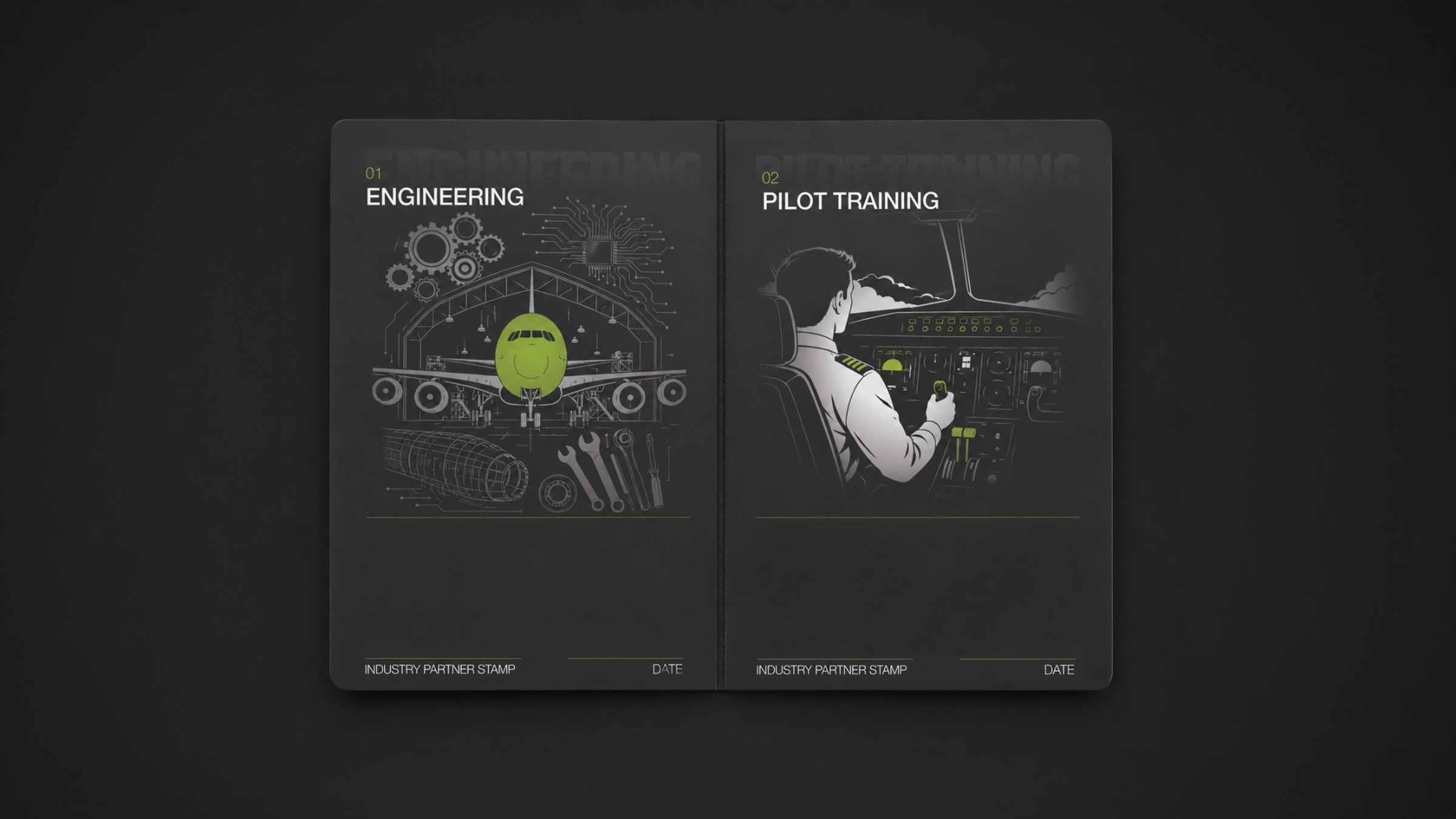
Ten stamps, one passport
Each chapter ends with a stamp in the student's Aviation Passport, earned by completing the session survey and scanning in. By July it holds ten. The programme is a structured pathway into the industry, not a licence, qualification or degree.
Three age bands, one journey
Discovery. What exists, who does it, what it feels like.
Direction. Subject choices, entry requirements and pathways.
Approach. Applications, licences, cadetships and first roles.
Each chapter is delivered in age-banded groups, so every student gets the version that meets them where they are.
Three online parent sessions
Parents and guardians do not sit in the student sessions. Three online sessions across the year help families support their student, the first following the first student session.
- Session one. The industry: roles, demand and how careers begin in the UAE.
- Session two. Pathways: university, apprenticeships, licences and cadetships.
- Session three. The plan: a family roadmap for the next five years.